


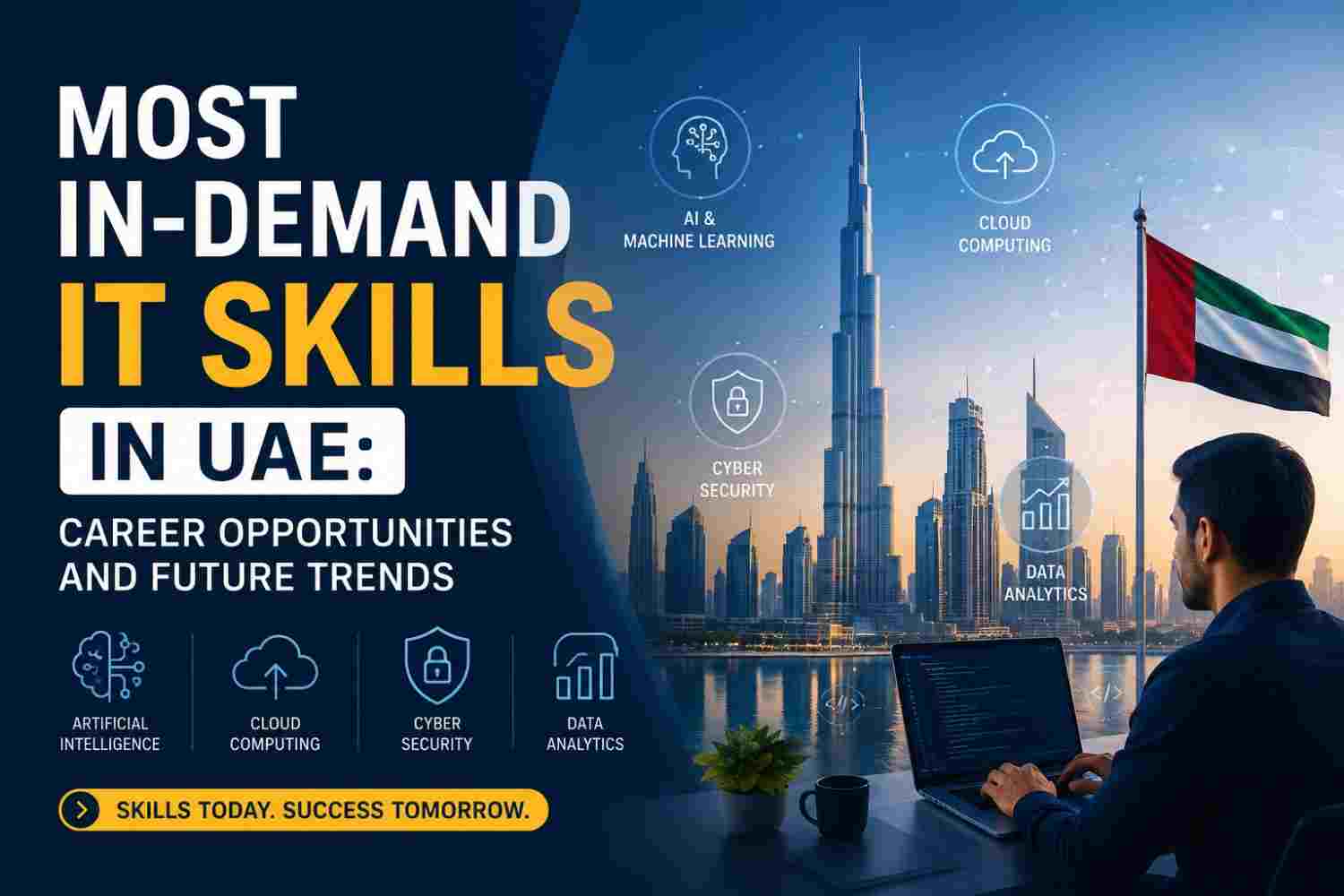
The UAE is rapidly becoming one of the world’s leading technology and innovation hubs. From artificial intelligence and cloud transformation to cybersecurity and automation, businesses across Dubai, Abu Dhabi and other UAE cities are investing heavily in digital technologies.
The UAE Digital Economy Strategy aims to increase the contribution of the digital economy to GDP from 9.7% in 2022 to 19.4% within 10 years. At the same time, national employment and skills strategies are placing greater emphasis on future-ready capabilities, lifelong learning and technology-driven sectors.
For students, graduates, IT professionals and career switchers, this creates an important question: Which IT skills are most in demand in the UAE, and which technology courses can lead to better career opportunities?
The answer increasingly points towards Artificial Intelligence and Machine Learning, Cybersecurity, Cloud Computing, DevOps and Automation, and Generative AI and AI Automation.
What Are the Most In-Demand IT Skills in the UAE?
The five IT skill areas with strong relevance to the UAE’s digital transformation are:
- Artificial Intelligence and Machine Learning
- Cybersecurity
- Cloud Computing
- DevOps and Automation
- Generative AI and AI Automation
These technologies are not limited to the IT industry. They are influencing banking, healthcare, retail, logistics, government, real estate, aviation, energy and other major sectors.
-
Artificial Intelligence and Machine Learning
Artificial Intelligence (AI) and Machine Learning (ML) are among the most important future technologies for the UAE. The country has established AI-focused strategies and policies with the ambition of becoming a global leader in AI development and adoption.
AI and ML enable organisations to analyse data, automate repetitive processes, predict business outcomes and develop intelligent products and services.
Career Opportunities in AI and Machine Learning
Professionals with AI and ML skills can explore roles such as:
- AI Engineer
- Machine Learning Engineer
- Data Scientist
- AI Developer
- Computer Vision Engineer
- NLP Engineer
- AI Solutions Architect
- Data Analyst
Career Outcomes
An AI and Machine Learning course can help learners build practical skills in programming, data analysis, machine learning algorithms, model development and AI applications. These skills can support careers in technology companies as well as AI-enabled roles across different industries.
Benefits of Learning AI and Machine Learning
- Develop future-ready technical skills
- Understand how intelligent systems are designed
- Build AI and ML projects for your portfolio
- Expand opportunities across multiple industries
- Prepare for emerging AI-focused job roles
- Develop a strong foundation for advanced AI technologies
For professionals who want to work at the intersection of technology and business, AI and ML can be a valuable long-term career skill.
As organisations become increasingly dependent on digital infrastructure, protecting systems, applications, networks and data has become a critical priority.
The UAE continues to strengthen its cybersecurity ecosystem through national policies and strategies. Dubai’s updated Cyber Security Strategy, for example, focuses on cyber skills, digital resilience, innovation and stronger cybersecurity capabilities.
The growing adoption of AI also creates new security requirements. In 2026, the UAE introduced a National Cyber Security Policy for Artificial Intelligence covering areas such as AI governance, infrastructure security, algorithm security, operational safety, threat monitoring and incident response.
Career Opportunities in Cybersecurity
Popular career paths include:
- Cybersecurity Analyst
- Security Engineer
- Ethical Hacker
- Penetration Tester
- Security Consultant
- SOC Analyst
- Network Security Engineer
- Cloud Security Specialist
- Information Security Analyst
Career Outcomes
A cybersecurity course can help learners understand threat detection, network security, vulnerability assessment, security monitoring and incident response.
With experience and relevant certifications, professionals can progress from entry-level security roles into specialist, consulting, engineering or security management positions.
Benefits of Learning Cybersecurity
- Build skills for protecting digital systems and data
- Develop knowledge of modern cyber threats
- Explore opportunities across public and private sectors
- Learn practical security concepts and tools
- Build a foundation for cybersecurity certifications
- Prepare for specialised security careers
Cybersecurity is particularly relevant for professionals who enjoy problem-solving, investigation and technology risk management.
-
Cloud Computing
Cloud Computing has become a fundamental part of modern IT infrastructure. Instead of relying only on traditional on-premises infrastructure, organisations use cloud platforms for computing, storage, databases, applications, analytics and other digital services.
For UAE businesses pursuing digital transformation, cloud skills can therefore provide strong career value.
Career Opportunities in Cloud Computing
Learners can work towards roles such as:
- Cloud Engineer
- Cloud Architect
- Cloud Administrator
- Cloud Solutions Architect
- Cloud Consultant
- Cloud Security Engineer
- Cloud DevOps Engineer
- Infrastructure Engineer
Knowledge of major cloud platforms and technologies can further improve a candidate’s ability to work with modern enterprise environments.
Career Outcomes
A Cloud Computing course can help learners understand cloud architecture, virtualisation, networking, storage, security and deployment models.
With practical experience, professionals can move towards cloud engineering, architecture, security or consulting roles.
Benefits of Learning Cloud Computing
- Build skills relevant to modern IT infrastructure
- Understand scalable technology environments
- Develop cloud deployment and management knowledge
- Improve career mobility across industries
- Complement skills in cybersecurity, DevOps and AI
- Prepare for cloud-focused certifications
Cloud Computing is also a powerful complementary skill. For example, AI applications increasingly require scalable computing infrastructure, while DevOps teams depend heavily on cloud environments.
-
DevOps and Automation
Modern organisations need to develop, test and release software faster while maintaining reliability and security. This is where DevOps and automation play an important role.
DevOps brings development and operations closer together, while automation reduces repetitive manual work and improves the efficiency of software delivery.
Career Opportunities in DevOps and Automation
Potential career paths include:
- DevOps Engineer
- DevSecOps Engineer
- Automation Engineer
- Site Reliability Engineer
- Cloud DevOps Engineer
- Release Engineer
- Platform Engineer
- Infrastructure Automation Engineer
Career Outcomes
A DevOps and Automation course can help learners develop knowledge of CI/CD pipelines, version control, containerisation, infrastructure automation and cloud-based deployment.
These skills can be especially valuable for IT professionals who want to move from traditional system administration or software development into modern engineering environments.
Benefits of Learning DevOps and Automation
- Learn how modern software delivery works
- Reduce repetitive operational tasks through automation
- Develop cloud and infrastructure skills
- Improve collaboration between development and operations teams
- Build practical CI/CD knowledge
- Create a pathway towards DevOps, DevSecOps and SRE roles
DevOps also works well as a complementary skill with Cloud Computing, Cybersecurity and AI.
-
Generative AI and AI Automation
Generative AI has rapidly expanded the possibilities of how businesses create content, analyse information, interact with customers and automate workflows.
For professionals, the opportunity is no longer limited to becoming a traditional AI developer. Businesses increasingly need people who understand how to apply AI to real-world processes.
The UAE is actively developing policies around responsible AI adoption, including privacy, data security, governance and safe AI use.
Career Opportunities in Generative AI and AI Automation
Potential roles and career directions include:
- Generative AI Specialist
- AI Automation Specialist
- AI Solutions Consultant
- Prompt Engineer
- AI Product Specialist
- AI Workflow Automation Specialist
- AI Business Analyst
- AI Integration Specialist
Career Outcomes
A Generative AI and AI Automation course can help learners understand large language models, prompt engineering, AI-powered workflows, automation tools and practical business applications.
The combination of AI knowledge and domain expertise can be particularly valuable. For example, a marketing professional can use AI automation for content workflows, while an IT professional can apply AI to support, documentation, monitoring and development processes.
Benefits of Learning Generative AI and AI Automation
- Learn how to use modern generative AI tools effectively
- Automate repetitive business workflows
- Improve productivity and efficiency
- Develop AI-powered solutions
- Enhance existing IT or business skills
- Prepare for emerging AI-enabled roles
- Understand responsible and secure AI adoption
The biggest advantage is that Generative AI can complement existing professional skills rather than requiring every learner to become a full-time programmer.
How These IT Skills Can Improve Career Opportunities in the UAE
The UAE’s technology ecosystem is evolving towards a knowledge-based and digital economy. Its National Employment Strategy 2031 specifically highlights future skills, lifelong learning, technology and AI-related sectors as part of its employment and workforce priorities.
For this reason, learning one technology can be useful, but combining complementary skills can create a stronger career profile.
For example:
- AI + Machine Learning + Cloud → AI/ML and cloud-focused roles
- Cybersecurity + Cloud → Cloud Security careers
- DevOps + Cloud → Cloud DevOps and infrastructure roles
- AI + Automation → AI automation and workflow roles
- Cybersecurity + AI → Emerging AI security opportunities
This approach can help professionals become more adaptable as technology and job requirements continue to change.
Career Outcomes: What Can You Expect After an IT Course?
Career outcomes depend on several factors, including previous education, technical knowledge, practical experience, certifications, projects and communication skills.
Depending on the chosen specialisation, learners may work towards:
- Entry-level IT roles
- Technical specialist positions
- Engineering roles
- Cloud and infrastructure careers
- Cybersecurity positions
- AI and data-related roles
- Automation and DevOps careers
- Technology consulting
- IT project and solution roles
A course alone does not guarantee employment. However, combining structured learning with hands-on projects, industry-relevant tools, certifications and continuous upskilling can make a candidate better prepared for technology careers.
Why Should You Learn In-Demand IT Skills in the UAE?
There are several benefits to investing in future-focused IT education:
- Access to diverse career paths:
AI, cloud, cybersecurity and automation skills can be applied across multiple industries. - Future-ready capabilities:
Technology continues to evolve, making continuous learning an important part of long-term career development. - Better career flexibility:
Digital skills can help professionals transition between industries and technology specialisations. - Stronger professional profile:
Practical technical skills, projects and certifications can strengthen a candidate’s overall profile. - Alignment with digital transformation:
The UAE’s focus on digital transformation and a knowledge-based economy creates an environment where advanced technology skills remain strategically important.
Which IT Skill Should You Learn First?
The right choice depends on your career goal.
| Career Goal | Recommended Skill |
| Build intelligent applications | AI & Machine Learning |
| Protect systems and data | Cybersecurity |
| Work with modern infrastructure | Cloud Computing |
| Automate software delivery | DevOps & Automation |
| Apply AI to business processes | Generative AI & AI Automation |
If you are a beginner, start with the area that best matches your interests and existing background. If you are already an IT professional, consider adding a complementary skill—for example, Cloud with DevOps or AI with Automation.
Future Trends in UAE’s IT Job Market
The future of IT careers in the UAE is likely to be shaped by AI adoption, cloud transformation, cybersecurity, automation and intelligent digital services.
Another important trend is the convergence of these technologies. AI systems need cloud infrastructure, cloud environments need security, DevOps enables faster deployment, and automation can connect AI with business processes.
This means future IT professionals may increasingly need a combination of technical skills rather than knowledge of only one technology.
The UAE’s focus on advanced skills and lifelong learning further reinforces the importance of continuously upgrading professional capabilities.
Frequently Asked Questions
Q. What are the most in-demand IT skills in the UAE?
AI, Cybersecurity, Cloud Computing, DevOps, Automation and Generative AI are among the most relevant IT skills for professionals in the UAE, including Abu Dhabi.
Q. Which IT course is best for a career in the UAE?
AI, Cybersecurity, Cloud Computing, DevOps and Generative AI can offer strong career paths in the UAE. Choose based on your interests, background and goals.
Q. Is AI a good career option in the UAE?
Yes. AI is a strategic technology area in the UAE, creating opportunities for skilled professionals across industries, particularly in technology-focused hubs such as Abu Dhabi and Dubai.
Q. Is cybersecurity in demand in Abu Dhabi?
Yes. Cybersecurity remains important as organisations protect digital infrastructure, data and AI systems. Abu Dhabi and the wider UAE continue investing in cybersecurity and digital resilience.
Q. What are the benefits of learning Cloud Computing?
Cloud Computing builds skills in infrastructure, deployment, scalability and cloud security, supporting career opportunities across the UAE, including Abu Dhabi, while complementing AI, DevOps and cybersecurity.
Q. Can Generative AI help with career growth?
Yes. Generative AI can improve productivity, automate workflows and support AI-powered solutions, helping professionals build valuable skills for technology careers in the UAE and Abu Dhabi.
Final Thoughts
The UAE’s technology landscape is moving rapidly towards AI-driven, cloud-enabled, automated and secure digital environments. For students and professionals planning their next career move, developing in-demand IT skills can be an important step towards becoming future-ready.
Artificial Intelligence and Machine Learning, Cybersecurity, Cloud Computing, DevOps and Automation, and Generative AI and AI Automation represent five valuable technology areas to consider.
The most successful IT professionals will not simply learn one tool or technology. They will continue building practical skills, combining complementary technologies and adapting to new developments.
If your goal is to build a long-term technology career in the UAE, now is the right time to identify your target career path, choose the relevant course and start developing hands-on, industry-focused skills.