


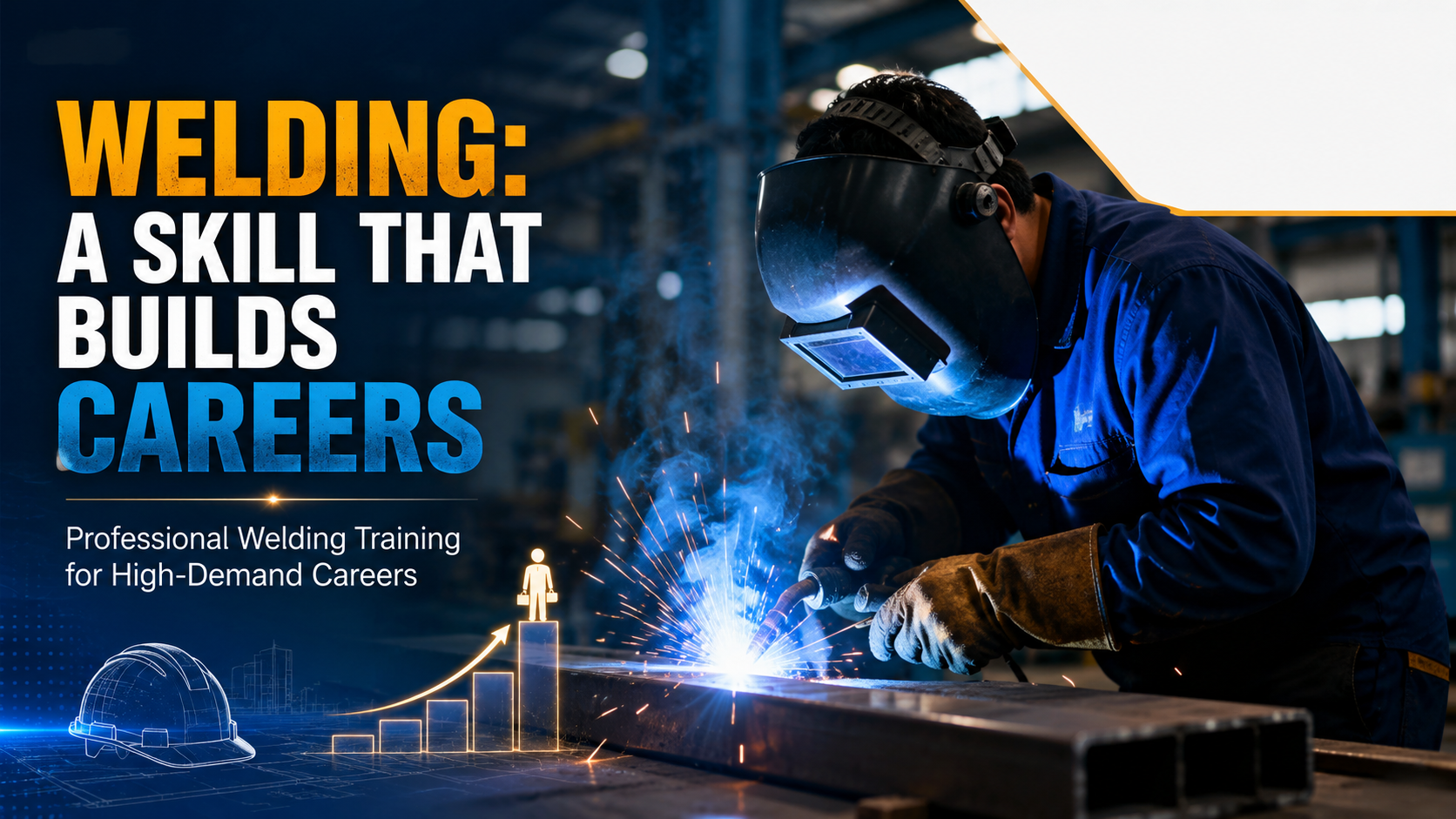
When people think about welding, they often imagine sparks flying from metal being joined together. While that’s certainly part of the job, modern welding is much more than simply connecting two pieces of metal. It is a highly skilled profession that plays a crucial role in industries such as construction, oil & gas, manufacturing, marine engineering, infrastructure development, renewable energy, and heavy fabrication.
Across the UAE, especially in Abu Dhabi, these industries continue to expand as the country invests in large-scale development projects and advanced industrial facilities. As a result, there is a growing demand for trained welders who can produce strong, safe, and high-quality welds that meet international industry standards.
However, becoming a skilled welder requires much more than learning how to operate a welding machine. Every weld must be accurate, durable, and capable of withstanding pressure, vibration, heat, and heavy loads. Even a small mistake can weaken an entire structure, leading to costly repairs, project delays or safety risks.
This is why understanding common welding defects is one of the most important parts of learning the trade. Knowing why welding defects occur—and more importantly, how to prevent them—is what separates a beginner from a professional welder.
A structured professional welding training programme gives students the practical skills, technical knowledge, and confidence required to produce quality welds while preparing them for rewarding career opportunities across the UAE.
Whether you are a school graduate, a technician looking to upgrade your skills, or someone planning a career change, learning welding can open the door to stable employment in some of the country’s fastest-growing industries.
What Is Welding? Understanding One of the World’s Most Valuable Industrial Skills
Welding is the process of permanently joining two or more pieces of metal by applying heat, pressure, or both. Once completed correctly, the welded joint becomes extremely strong and is capable of supporting heavy loads and harsh working conditions.
Unlike bolts, screws, or rivets, welding creates a permanent connection, making it one of the most widely used manufacturing and fabrication techniques in the world.
Today, welding is used in almost every major industry because metal structures and equipment form the backbone of modern infrastructure.
Some common applications include:
- Constructing residential and commercial buildings
- Fabricating steel structures
- Manufacturing industrial machinery
- Building pipelines and storage tanks
- Shipbuilding and marine repairs
- Automotive manufacturing
- Aircraft maintenance
- Power plants and renewable energy projects
- Mechanical maintenance and repair work
Without skilled welders, many of the structures and machines we rely on every day simply could not be built or maintained.
Why Skilled Welders Are in High Demand Across the UAE
The UAE has become one of the fastest-growing industrial economies in the Middle East. Major investments in infrastructure, transportation, renewable energy, manufacturing, and oil & gas continue to create opportunities for technically skilled professionals.
As industries expand, employers increasingly seek welders who can produce reliable, inspection-ready welds while working safely and efficiently.
Industries That Hire Skilled Welders in the UAE
| Industry | Role of Welders |
| Construction | Structural steel fabrication, commercial buildings, bridges, warehouses |
| Oil & Gas | Pipelines, refineries, pressure vessels, offshore maintenance |
| Manufacturing | Industrial equipment, machinery and production facilities |
| Marine & Shipbuilding | Vessel fabrication and repair |
| Infrastructure | Metro projects, utilities, transportation systems |
| Mechanical Maintenance | Plant maintenance and equipment repairs |
| Renewable Energy | Solar mounting systems and industrial installations |
| Heavy Engineering | Steel fabrication and customised industrial structures |
These industries require professionals who understand welding quality, safety procedures, and inspection standards. Employers are not simply looking for people who can operate welding equipment—they want individuals who can consistently produce welds that meet quality requirements while reducing rework and material wastage.
This is one of the reasons why completing a professional welding course can significantly improve employability and career prospects in the UAE.
Is Welding a Good Career Choice in the UAE?
For many students and job seekers, one of the first questions is whether welding offers long-term career opportunities. The answer is yes—particularly for individuals who are willing to develop practical skills and continuously improve their expertise.
A career in welding offers several advantages:
- High demand across multiple industries
- Opportunities to work on large infrastructure and industrial projects
- Practical, hands-on work environment
- Scope for career progression through additional certifications
- Possibility of specialising in advanced welding techniques such as TIG, MIG, or Pipe Welding
- Opportunities to work both within the UAE and internationally
As welders gain experience and develop specialised skills, they may progress into supervisory, inspection, fabrication, or quality control roles, opening up even more career opportunities.
What Are Common Welding Defects?
Before learning how to weld professionally, it is important to understand what can go wrong during the welding process.
Definition
A welding defect is any flaw or irregularity in a welded joint that reduces its strength, durability, appearance, or overall quality. Welding defects may occur on the surface of the weld or inside the joint and can affect the safety and performance of the finished structure.
Some defects are easy to identify through visual inspection, while others require specialised testing methods to detect.
Regardless of their size, welding defects can lead to:
- Reduced structural strength
- Failed quality inspections
- Increased repair costs
- Project delays
- Material wastage
- Workplace safety risks
Understanding these defects is one of the first lessons taught during professional welding training, as it helps students develop the ability to produce stronger and more reliable welds from the very beginning.
Why Do Beginners Make Welding Mistakes?
Many people assume welding defects occur because welding is difficult. In reality, most defects result from a lack of practical experience rather than the welding process itself.
Beginners often struggle because they are still learning how different factors affect the weld. Even a small change in machine settings or technique can significantly impact the final result.
Some of the most common reasons beginners experience welding defects include:
- Incorrect welding current or voltage
- Poor electrode or torch angle
- Inconsistent travel speed
- Improper surface preparation
- Incorrect shielding gas settings
- Choosing the wrong filler material
- Lack of understanding of welding positions
- Limited practical workshop experience
The good news is that these mistakes are completely normal during the learning stage. With proper instruction and regular hands-on practice, students gradually develop the control and confidence needed to produce consistent, high-quality welds.
This is why experienced instructors focus on correcting techniques early in the training process, helping learners build strong fundamentals before moving on to more advanced welding applications.
The 10 Most Common Welding Defects Every Future Welder Should Know
One of the key objectives of any professional welding course is helping students recognise common welding defects before they become serious problems. By understanding their causes and learning the correct preventive techniques, future welders can improve the quality of their work and meet the expectations of employers across the UAE.
In the next section, we’ll explore the 10 most common welding defects, explain why they occur, how they affect weld quality, and how practical welding training helps students prevent them from the very beginning of their careers.
Understanding Common Welding Defects and How Professional Training Helps Prevent Them
Now that you understand what welding is, why it is an in-demand career in the UAE, and why weld quality is so important, let’s look at the common welding defects every aspiring welder should know.
Many students worry about making mistakes when they first start welding. The good news is that welding defects are a normal part of the learning process. Every experienced welder has made them at some point. The difference is that trained professionals know how to identify these defects, understand why they occur, and apply the correct techniques to prevent them.
This is exactly why a professional welding training course focuses heavily on practical workshop sessions. Students don’t just learn how to weld—they learn how to inspect their work, identify problems, and improve with every practice session.
Top 10 Common Welding Defects Every Student Should Learn About
1. Porosity
Porosity is one of the most frequently encountered welding defects, especially among beginners. It appears as tiny holes or air pockets trapped inside the weld metal while it cools and solidifies. Although these holes may seem small, they reduce the strength and durability of the welded joint.
In industries such as oil & gas, construction, and heavy fabrication, porosity is unacceptable because it can lead to weld failure under pressure or heavy loads.
Why Does Porosity Occur?
The most common causes include:
- Moisture on the workpiece
- Rust, grease, paint, or dirt on the metal
- Incorrect shielding gas flow
- Damp welding electrodes
- Excessive arc length
- Poor welding technique
How Students Learn to Prevent It
During practical welding classes, students are taught that preparation is just as important as welding itself. Before striking an arc, they learn how to clean metal surfaces, store electrodes correctly, adjust shielding gas, and maintain a stable arc.
With regular practice, they quickly understand that good preparation results in stronger, cleaner welds.
2. Lack of Fusion
Lack of fusion occurs when the molten weld metal does not properly bond with the base metal or the previous weld pass. The weld may look acceptable from the outside, but internally, sections remain disconnected, making the joint much weaker than it should be.
This is one of the defects that quality inspectors pay close attention to because it directly affects structural strength.
Common Causes
- Low welding current
- Incorrect electrode angle
- Fast travel speed
- Poor joint preparation
- Improper welding technique
How Professional Training Helps
One of the biggest advantages of hands-on training is that instructors observe every weld students produce. If a learner is moving too quickly or using the wrong angle, corrections are made immediately.
Repeated practical exercises help students understand how heat, travel speed, and welding position affect fusion.
3. Incomplete Penetration
A weld should fuse completely through the joint thickness. When this does not happen, it is known as incomplete penetration.
Although the weld may appear complete on the surface, it remains weak at its root and may fail when subjected to heavy loads or vibration.
Causes
- Low amperage
- Incorrect root gap
- Thick material without proper edge preparation
- Fast travel speed
- Poor joint design
What Students Learn During Training
Professional welding courses teach students how to prepare joints correctly, select the appropriate welding current, and adjust travel speed according to material thickness.
By practising on different joint types, students gain confidence in producing strong welds with proper penetration.
4. Slag Inclusion
Slag is a protective layer produced during certain welding processes such as Shielded Metal Arc Welding (SMAW). If this slag is not removed before the next welding pass, it becomes trapped inside the weld, creating what is known as slag inclusion.
This reduces weld strength and often leads to failed quality inspections.
Causes
- Poor cleaning between weld passes
- Incorrect electrode angle
- Low welding current
- Improper welding technique
How Training Prevents Slag Inclusion
Students learn that every weld pass must be inspected and cleaned before continuing. Practical sessions teach them the correct use of chipping hammers, wire brushes, and grinders, helping them develop professional habits from day one.
5. Undercut
Undercut is a groove that forms along the edge of the weld when too much base metal melts away and is not filled with weld metal.
Although it may appear to be a small defect, it creates weak points where cracks can develop over time.
Causes
- High welding current
- Long arc length
- Incorrect torch angle
- Excessive travel speed
Prevention Through Training
Students practise maintaining a consistent arc length and correct travel speed while instructors monitor bead formation. These exercises help them produce smooth, even welds without undercut.
6. Welding Cracks
Among all welding defects, cracks are considered the most serious because they directly affect structural integrity.
Cracks may continue to grow after welding, eventually causing complete joint failure if not repaired.
Types of Cracks
Some common examples include:
- Hot cracks
- Cold cracks
- Root cracks
- Toe cracks
- Crater cracks
- Longitudinal cracks
Causes
- Rapid cooling
- Hydrogen contamination
- Poor welding sequence
- Incorrect filler material
- High residual stress
What Students Learn
Professional welding training introduces students to proper welding procedures, heat control, filler material selection, and cooling methods that help minimise cracking.
7. Spatter
Spatter consists of tiny droplets of molten metal scattered around the weld during welding.
Although spatter usually affects appearance more than strength, excessive spatter indicates poor machine settings and increases finishing time.
Causes
- High current
- Incorrect voltage
- Long arc length
- Poor shielding gas settings
Prevention
Students experiment with different machine settings during practical classes until they understand how voltage, current, and wire feed speed influence weld quality.
8. Burn-Through
Burn-through occurs when excessive heat melts completely through the metal, leaving a hole in the workpiece.
This defect is particularly common when welding thin materials.
Causes
- High amperage
- Slow travel speed
- Thin metal
- Large root gap
How Training Helps
Students learn to control heat input, select suitable welding parameters, and use techniques designed specifically for thin materials.
9. Overlap
Overlap occurs when molten weld metal spreads beyond the weld toe without properly fusing to the base metal.
Although the weld may appear larger, it is actually weaker because complete fusion has not occurred.
Causes
- Slow travel speed
- Low welding current
- Incorrect torch angle
- Excessive weld deposition
Prevention
Through repeated practice, students learn correct bead placement and torch manipulation techniques that produce strong, well-fused welds.
10. Distortion
Distortion refers to unwanted bending or warping caused by uneven heating and cooling during welding.
Large fabricated structures often require careful planning to minimise distortion.
Causes
- Excessive heat
- Poor clamping
- Incorrect welding sequence
- Uneven heat distribution
Prevention
Students learn practical techniques such as tack welding, balanced welding sequences, proper fixturing, and controlled cooling to maintain dimensional accuracy.
Why Do Welding Defects Happen?
Although there are many different welding defects, most of them can be traced back to a few common causes.
| Common Cause | Possible Welding Defects |
| Poor surface cleaning | Porosity, slag inclusion |
| Incorrect welding current | Burn-through, undercut, poor penetration |
| Fast travel speed | Lack of fusion, incomplete penetration |
| Wrong electrode angle | Slag inclusion, overlap |
| Damp electrodes | Porosity, cracking |
| Incorrect shielding gas | Porosity and oxidation |
| Limited practical experience | Multiple welding defects |
| Poor machine setup | Inconsistent weld quality |
The encouraging news is that almost all of these issues can be significantly reduced through proper instruction and regular practical training.
Welding Defects vs. Welding Discontinuities – What’s the Difference?
Many beginners think these two terms mean the same thing, but they are different.
| Welding Discontinuity | Welding Defect |
| Any irregularity in a weld | A discontinuity that exceeds acceptable quality standards |
| May still be acceptable under welding codes | Requires repair or rejection |
| Does not always reduce performance | Affects strength, quality, or safety |
| May pass inspection | Usually fails inspection |
Learning this distinction is important because professional welders must understand inspection standards and industry codes, not just the welding process itself.
How Professional Welding Training Helps Prevent Common Welding Defects
The biggest difference between an untrained welder and a professionally trained welder is not the ability to operate a welding machine—it’s the ability to produce consistent, high-quality welds.
During a structured welding course, students repeatedly practise real workshop tasks while receiving guidance from experienced instructors. This practical learning helps them understand why defects occur and how to avoid them before they become routine mistakes.
Professional training helps students:
- Set up welding machines correctly.
- Prepare metal surfaces before welding.
- Select the right electrodes and filler materials.
- Maintain proper welding speed and arc length.
- Perform visual inspections after welding.
- Correct defects through supervised practice.
- Follow industry-standard welding procedures.
- Develop safe working habits.
These practical skills are exactly what employers expect from entry-level welders in industries across the UAE.
Quick Welding Defect Prevention Checklist
Before every welding job, experienced welders follow a simple quality routine.
| Stage | Best Practice |
| Before Welding | Clean the workpiece thoroughly and prepare the joint correctly. |
| Machine Setup | Check voltage, current, polarity, and shielding gas flow. |
| During Welding | Maintain a steady arc, correct angle, and consistent travel speed. |
| Between Weld Passes | Remove slag completely and inspect previous welds. |
| After Welding | Perform visual inspection and check for defects. |
| Continuous Improvement | Practise regularly and learn from instructor feedback. |
Following these steps consistently helps reduce defects, improve productivity, and produce stronger, inspection-ready welds.
Build a Successful Welding Career in the UAE with Professional Training
Understanding common welding defects is only one part of becoming a skilled welder. The next step is learning how to apply this knowledge in real workshop environments and developing the confidence to work on industrial projects safely and efficiently.
This is where professional welding training becomes essential. A well-designed welding course not only teaches technical skills but also prepares students for employment by combining practical experience, industry knowledge, workplace safety, and quality standards.
If you’re considering a career in welding, this section will help you understand who can join a welding course, what skills you’ll learn, the career opportunities available in the UAE, and why investing in professional training is the best way to build a successful future.
If you’re planning a long-term career in welding and inspection, you may also be interested in:
Arc Welding, Gas Welding & Cutting Training
Certified Welding Inspector (CWI) Training
VT & PT Level II Certification
Lean Management in Welding Course
Welding Auditor Certification
Certified Welding Design Engineer Program
Painting & Coating Inspector Course
Why Professional Welding Training Is Better Than Learning on the Job
Many people believe they can learn welding simply by working alongside experienced welders. While workplace exposure is valuable, learning without proper guidance often leads to inconsistent techniques and habits that are difficult to correct later.
Professional welding training provides a structured learning environment where students build strong fundamentals before entering the workplace.
Instead of learning through trial and error, trainees receive step-by-step instruction from experienced professionals. They understand why a particular technique works, how to set up equipment correctly, and how to identify mistakes before they become major welding defects.
Another important advantage is that students get the opportunity to practise repeatedly on different materials, joint types, and welding positions. This practical exposure helps improve confidence, precision, and consistency—qualities that employers value highly.
By the end of a professional welding course, students are better prepared to produce safe, high-quality welds that meet industry expectations.
Who Can Join a Welding Course?
One of the biggest misconceptions about welding is that only experienced technicians can learn it. In reality, professional welding training is designed for learners from different educational and professional backgrounds.
A welding course is suitable for:
- School graduates looking for a technical career.
- ITI and vocational education students.
- Diploma holders in mechanical or civil engineering.
- Helpers and assistants working in fabrication workshops.
- Construction workers wanting to upgrade their skills.
- Fabricators who want formal welding training.
- Maintenance technicians.
- Individuals planning a career change.
- Anyone interested in learning a practical trade with strong employment opportunities.
No matter your starting point, the most important qualities are a willingness to learn, attention to detail, and commitment to workplace safety.
What Skills Will You Learn During Professional Welding Training?
A quality welding programme is designed to prepare students for real industrial environments. Instead of focusing only on theory, it develops practical skills that employers expect from entry-level welders.
Understanding Different Welding Processes
Students gain practical exposure to commonly used welding methods, including:
- Shielded Metal Arc Welding (SMAW)
- Gas Metal Arc Welding (MIG)
- Gas Tungsten Arc Welding (TIG)
- Flux-Cored Arc Welding (FCAW)
Learning multiple welding processes increases flexibility and opens up more employment opportunities across different industries.
Welding Equipment Setup
Students learn how to:
- Set welding current and voltage.
- Select appropriate electrodes and filler materials.
- Adjust shielding gas flow.
- Configure welding machines for different applications.
- Maintain welding equipment safely.
Understanding machine setup is essential for producing consistent weld quality and preventing common welding defects.
Metal Preparation and Joint Fit-Up
Before welding begins, proper preparation is critical.
Students learn:
- Surface cleaning techniques.
- Joint preparation methods.
- Bevel angle selection.
- Root gap measurement.
- Material positioning.
Good preparation reduces the chances of porosity, incomplete penetration, and lack of fusion.
Welding Positions
Industrial welding is rarely performed only in the flat position. Professional training introduces students to different welding positions such as:
- Flat Position
- Horizontal Position
- Vertical Position
- Overhead Position
Developing confidence in multiple positions makes students more versatile and job-ready.
Welding Inspection and Quality Control
Students also learn how to evaluate the quality of their own work.
Topics include:
- Visual inspection
- Identifying welding defects
- Basic non-destructive testing concepts
- Weld measurement
- Quality standards
- Documentation
These skills are particularly valuable for industries that follow strict quality control procedures.
Workplace Safety
Safety is a fundamental part of every welding course.
Students learn:
- Personal Protective Equipment (PPE)
- Fire prevention
- Electrical safety
- Safe handling of welding gases
- Workshop safety procedures
- Hazard identification and risk awareness
A strong understanding of safety protects both the welder and those working nearby.
Career Opportunities After Completing a Welding Course
Professional welding skills are required in almost every industrial sector. After completing a recognised welding training programme, graduates can pursue opportunities in various industries across the UAE and internationally.
Some common career options include:
| Career Role | Primary Responsibilities |
| Welder | General fabrication and metal joining |
| Structural Welder | Steel buildings, bridges and infrastructure |
| Pipe Welder | Pipelines, oil & gas installations |
| Fabrication Technician | Manufacturing and metal fabrication |
| Mechanical Maintenance Technician | Repair and maintenance of industrial equipment |
| Shipyard Welder | Marine construction and repair |
| Manufacturing Technician | Production and assembly operations |
| Welding Inspector* | Quality inspection after gaining additional qualifications |
*Advanced inspection roles usually require additional certifications and industry experience.
With experience, welders may also progress into supervisory positions, workshop management, quality assurance, or specialised welding roles.
Average Welder Salary in the UAE
One of the most common questions prospective students ask is, “How much can I earn after completing a welding course?”
The answer depends on several factors, including your skill level, certifications, employer, industry, experience, and the type of welding you perform.
The table below provides a general overview of salary ranges commonly seen in the UAE.
| Experience Level | Estimated Monthly Salary (AED) |
| Entry-Level Welder | 1,800 – 2,800 |
| Skilled Welder | 2,800 – 4,500 |
| Experienced Welder | 4,500 – 7,000+ |
| Specialist TIG/Pipe Welder | 6,000 – 10,000+ |
Please note: These figures are approximate and may vary depending on the employer, overtime, project type, certifications, and industry demand.
As welders gain practical experience, specialise in advanced welding techniques, and continue upgrading their skills, their earning potential generally increases.
Why the UAE Continues to Need Skilled Welders
The UAE’s long-term economic development plans continue to drive investment in sectors that rely heavily on welding and metal fabrication.
These include:
- Commercial and residential construction.
- Oil & gas facilities.
- Manufacturing plants.
- Renewable energy projects.
- Transport infrastructure.
- Marine engineering.
- Industrial maintenance.
- Heavy engineering and fabrication.
Every one of these sectors requires qualified welders who can produce strong, safe, and inspection-ready welds. As technology and quality standards continue to evolve, employers increasingly prefer candidates with structured training and practical workshop experience.
Why Choose Professional Welding Training at Duke Training Centre?
Choosing the right training institute is one of the most important decisions you can make when starting your welding career.
At Duke Training Centre, the focus is on preparing students for real workplace environments rather than simply teaching theory. Training is designed to help learners develop practical skills, confidence, and an understanding of industry expectations.
Students benefit from:
- Practical hands-on workshop training.
- Guidance from experienced instructors.
- Industry-focused learning.
- Training on modern welding equipment.
- Strong emphasis on safety and quality.
- Opportunities to improve technical and practical skills.
- Learning environments that simulate real industrial conditions.
The objective is to help students become confident professionals who are ready to contribute effectively in construction, fabrication, manufacturing, maintenance, and other industrial sectors across the UAE.
Final Thoughts
A successful welding career starts with the right foundation. Understanding common welding defects is important because it teaches future welders how to produce stronger, safer, and higher-quality welds. However, knowledge alone is not enough. Real improvement comes from practising under expert guidance, learning industry-approved techniques, and developing the confidence to apply those skills in real workplace environments.
Professional welding training gives students the opportunity to build those skills step by step. From learning different welding processes and safety procedures to understanding quality inspection and defect prevention, every lesson contributes to becoming a more capable and employable welder.
If you’re looking to begin a career in welding or upgrade your existing skills, a structured training programme can provide the practical experience and technical knowledge needed to succeed.
Duke Training Centre is committed to helping aspiring welders prepare for rewarding careers through industry-focused, hands-on welding training in Abu Dhabi. With practical workshops, experienced instructors, and a focus on workplace readiness, students gain the confidence to meet the expectations of employers across the UAE.
Frequently Asked Questions (FAQs)
Is welding a good career in the UAE?
Yes. Welding continues to be an in-demand profession in sectors such as construction, oil & gas, manufacturing, marine engineering, infrastructure, and industrial maintenance. Skilled welders with practical experience and recognised training have strong employment opportunities.
Do I need previous experience to join a welding course?
No. Many welding courses are suitable for beginners. Professional training programmes start with the fundamentals and gradually build practical skills through supervised workshop sessions.
What is the most common welding defect?
Porosity is one of the most common welding defects. It occurs when gas becomes trapped inside the weld due to contamination, moisture, poor shielding gas coverage, or incorrect welding techniques.
How can welding defects be prevented?
Most welding defects can be prevented through proper surface preparation, correct machine settings, suitable welding techniques, quality inspection, and regular practical training under experienced instructors.
What skills are most important for a successful welder?
Successful welders combine technical knowledge with practical ability. Important skills include attention to detail, hand-eye coordination, problem-solving, equipment handling, quality inspection, and a strong commitment to workplace safety.
Can I get a job after completing a welding course?
Completing a professional welding course helps you develop industry-relevant skills that employers value. While employment depends on factors such as experience, interview performance, and market demand, structured practical training can improve your job readiness and career prospects.